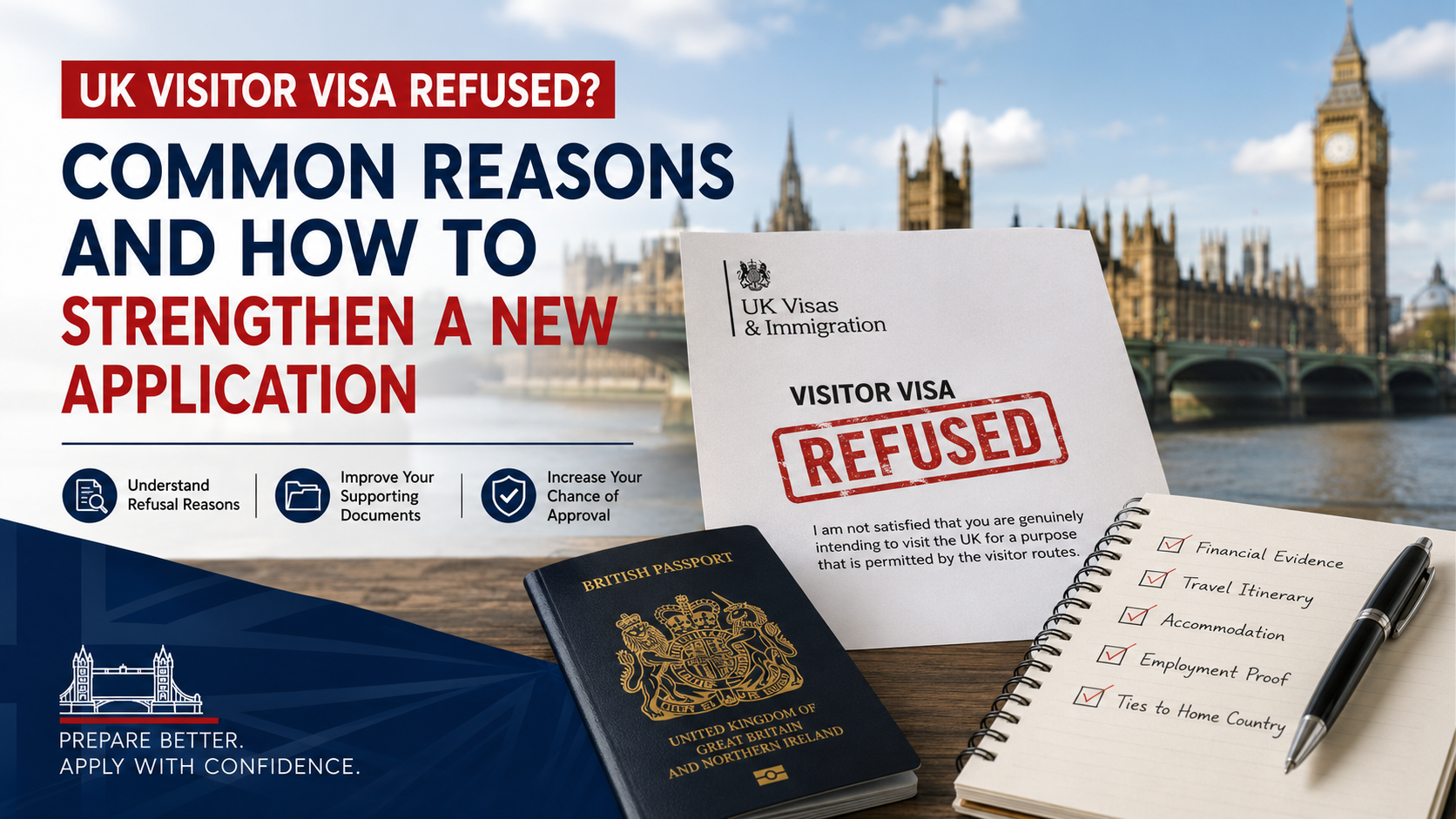

Receiving a UK visitor visa refusal can be frustrating and disappointing, especially when you have already planned your trip. However, a refusal does not necessarily mean that you cannot visit the United Kingdom in the future.
Every year, many applicants receive a UK visitor visa refusal because they fail to provide sufficient evidence regarding their finances, travel plans, personal circumstances, or intention to return to their home country after their visit. Understanding the reasons behind a refusal is often the key to preparing a stronger application.
In this guide, we explain the most common UK visitor visa refusal reasons, how UK Visas and Immigration (UKVI) assesses applications, and what steps you can take to improve your chances of success when reapplying.
Table of Contents
- Why Are UK Visitor Visas Refused?
- Understanding UK Visitor Visa Requirements
- Most Common Reasons for UK Visitor Visa Refusals
- Insufficient Financial Evidence
- Problems with Supporting Documents
- Concerns About Returning to Your Home Country
- Inconsistencies in the Application
- Previous Immigration History Issues
- How to Prepare a Stronger Reapplication
- When Professional Immigration Guidance May Help
- Final Checklist Before Submitting a New Application
Why Are UK Visitor Visas Refused?
Most UK visitor visa refusals occur because applicants do not provide enough evidence to satisfy UKVI that they are genuine visitors who intend to leave the UK at the end of their stay.
Common concerns include:
- Insufficient financial evidence
- Missing or unreliable supporting documents
- Weak evidence of ties to the home country
- Inconsistent information in the application
- Previous immigration history issues
The refusal letter usually explains the reasons behind the decision. Carefully reviewing those concerns is essential before considering a new application.
Understanding UK Visitor Visa Requirements
Before applying, it is important to understand the requirements that UKVI expects applicants to meet.
Genuine Visitor Requirement
Applicants must demonstrate that they genuinely intend to visit the UK for a permitted purpose, such as:
- Tourism
- Visiting family or friends
- Business meetings
- Academic visits
- Medical treatment
Temporary Stay Requirement
UKVI must be satisfied that the applicant intends to leave the UK at the end of the visit and will not remain beyond the authorised period.
Financial Requirements
Applicants should show that they can support themselves during their stay without relying on public funds or working illegally in the UK.
Supporting Evidence
Supporting documents help verify the information provided in the application and may include:
- Bank statements
- Employment documents
- Business records
- Travel itinerary
- Accommodation details
The UK Government provides official guidance regarding visitor visa supporting documents, which applicants should review before submitting their application:
Visitor Visa Supporting Documents Guidance
Travel Purpose Documentation
The purpose of the visit should be supported with evidence such as:
- Invitation letters
- Hotel bookings
- Event registrations
- Conference confirmations
Most Common Reasons for UK Visitor Visa Refusals
UKVI officers assess each application individually. Refusals typically arise when the evidence provided does not adequately support the applicant’s claims.
The most common refusal categories include:
- Financial concerns
- Documentation problems
- Concerns about returning home
- Inconsistencies in information
- Previous immigration history issues
Understanding these areas can help applicants avoid mistakes in future applications.
Insufficient Financial Evidence
Financial evidence is one of the most scrutinised aspects of a visitor visa application.
Unexplained Deposits
Large deposits appearing shortly before the application may raise concerns if their source cannot be clearly explained.
Applicants should provide evidence demonstrating where significant funds originated.
Inconsistent Bank Statements
Bank statements should reflect a stable financial situation that is consistent with the applicant’s declared income and personal circumstances.
Irregular account activity can lead to questions regarding financial credibility.
Lack of Income Proof
Applicants should provide supporting evidence of their income, including:
- Payslips
- Employment contracts
- Tax records
- Business income documents
Sponsorship Evidence Issues
When a sponsor is funding the visit, UKVI may expect evidence showing:
- The sponsor’s financial ability
- Their relationship to the applicant
- The purpose of the sponsorship
Financial Credibility Concerns
The overall financial picture must make sense. If declared income appears inconsistent with spending patterns or savings, concerns may arise regarding the reliability of the information provided.
Problems with Supporting Documents
Even strong applications can face difficulties if supporting documents are incomplete or unreliable.
Missing Documents
Missing evidence can prevent UKVI from fully assessing an application.
Examples include:
- Missing bank statements
- Missing employment evidence
- Missing invitation letters
Poor-Quality Translations
Documents not in English should generally be accompanied by appropriate translations that accurately reflect the original content.
Unverified Employment Letters
Employment letters should include:
- Employer details
- Job title
- Salary information
- Leave approval dates
Letters lacking verification details may carry less evidential weight.
Missing Travel Plans
A clear explanation of travel plans can strengthen an application.
This may include:
- Intended travel dates
- Places to visit
- Planned activities
Incomplete Accommodation Details
Applicants should provide information regarding where they will stay during their visit, whether in hotels or with family and friends.
Concerns About Returning to Your Home Country
One of the most important factors in visitor visa applications is demonstrating strong ties outside the UK.
Employment Ties
Stable employment can help show that an applicant has reasons to return home after their visit.
Useful evidence may include:
- Employment contracts
- Payslips
- Employer letters
Business Ownership
Self-employed applicants can provide evidence such as:
- Business registration documents
- Tax returns
- Client contracts
- Business bank statements
Family Commitments
Family responsibilities may demonstrate strong personal ties to the home country.
Property Ownership
Property ownership can support an applicant’s case, although it should not be relied upon as the sole evidence of ties.
Academic Commitments
Students can strengthen applications by providing:
- Enrollment letters
- Academic schedules
- Confirmation of studies
Inconsistencies in the Application
Inconsistent information is a frequent reason for refusal.
Different Information Across Documents
Information should remain consistent throughout:
- Application forms
- Bank statements
- Employment letters
- Supporting documents
Incorrect Travel History
Applicants should accurately disclose previous international travel and visa history.
Conflicting Employment Details
Differences between employment records and application forms can create doubts regarding credibility.
Errors in Application Forms
Simple mistakes can sometimes have serious consequences.
Applicants should carefully review every section before submission.
Previous Immigration History Issues
Past immigration history may influence how future applications are assessed.
Previous Visa Refusals
Previous refusals do not automatically prevent future approval.
However, applicants should address the issues identified in earlier decisions.
Overstays
Previous overstays may raise concerns regarding compliance with immigration rules.
Incorrect Disclosures
Failing to disclose previous refusals or immigration history can damage credibility and affect future applications.
Impact on Future Applications
Transparency is essential. Accurate disclosure allows applicants to explain circumstances and demonstrate improvements since earlier applications.
How to Prepare a Stronger Reapplication
A refusal does not necessarily mean the end of your travel plans.
Many applicants succeed after preparing a stronger application that addresses previous concerns.
Review the Refusal Letter Carefully
The refusal notice often provides valuable insight into the caseworker’s concerns.
Understanding those concerns should be the starting point for any reapplication.
Gather Stronger Evidence
Applicants should focus on providing:
- Clear financial records
- Strong employment evidence
- Detailed travel plans
- Proof of ties to their home country
Address Previous Concerns Directly
If concerns were raised regarding finances, employment, sponsorship, or travel purpose, additional evidence should specifically address those issues.
Organise Supporting Documents
A well-organised application helps caseworkers review information more efficiently.
Documents should be consistent, easy to understand, and clearly labelled.
Seek Regulated Immigration Guidance
Professional advice may help identify weaknesses and improve the overall presentation of an application.
When Professional Immigration Guidance May Help
Some situations are more complex and may benefit from professional assistance.
Complex Travel History
Applicants with extensive travel records or previous refusals may require additional preparation.
Multiple Refusals
Repeated refusals often indicate underlying issues that should be carefully addressed before reapplying.
Self-Employed Applicants
Self-employed individuals may need assistance presenting business and financial evidence effectively.
Sponsored Visits
Applications relying on sponsors often require detailed supporting documentation.
Family Visit Applications
Family visits can involve additional evidence relating to relationships, accommodation, and financial support.
Final Checklist Before Submitting a New Application
Before submitting a new application, review the following checklist:
Financial Documents
✓ Recent bank statements
✓ Income evidence
✓ Tax documents where applicable
✓ Explanation for significant transactions
Employment Evidence
✓ Employment letter
✓ Payslips
✓ Leave approval confirmation
Travel Itinerary
✓ Planned travel dates
✓ Purpose of visit
✓ Supporting invitations where relevant
Accommodation Details
✓ Hotel reservations or host information
✓ Address details
Supporting Letters
✓ Sponsor letter if applicable
✓ Invitation letter where relevant
Consistency Review
✓ Check all dates
✓ Verify financial figures
✓ Ensure information matches across all documents
✓ Review travel history disclosures
Frequently Asked Questions
Why was my UK visitor visa refused?
Applications may be refused because of insufficient evidence, financial concerns, document issues, or doubts about whether the applicant will leave the UK after their visit.
Can I apply again after a UK visitor visa refusal?
Yes. Many applicants submit a new application after addressing the concerns raised in the refusal decision.
How soon can I reapply after a UK visitor visa refusal?
There is generally no mandatory waiting period, but it is advisable to resolve the reasons for refusal before reapplying.
What documents are most important for a UK visitor visa?
Bank statements, employment evidence, travel plans, accommodation details, and proof of ties to your home country are commonly important.
Can a UK visitor visa be refused because of bank statements?
Yes. Unexplained transactions, inconsistent balances, or insufficient funds can create concerns.
Do previous visa refusals affect future applications?
They can. Applicants should declare previous refusals and provide accurate information in future applications.
Can self-employed applicants obtain a UK visitor visa?
Yes. Self-employed applicants can qualify if they provide sufficient evidence regarding their business activities and finances.
Is a sponsor letter enough for a UK visitor visa?
No. A sponsor letter alone is usually not sufficient and should be supported by additional evidence.
Can Moroccan applicants face additional challenges?
Applicants from Morocco should ensure they provide comprehensive evidence demonstrating the purpose of travel and their intention to return home after the visit.
Should I seek professional immigration advice after a refusal?
Applicants with complex circumstances or repeated refusals may benefit from guidance from a regulated immigration adviser.
Conclusion
A UK visitor visa refusal can be discouraging, but it does not automatically prevent future approval. In many cases, the key lies in understanding the reasons for refusal, gathering stronger supporting evidence, and ensuring that all information is accurate, consistent, and well documented.
By carefully addressing the concerns identified in the refusal letter and presenting a stronger application, applicants can significantly improve their chances of success when reapplying.
If you have received a refusal and are unsure how to proceed, professional guidance can help you identify weaknesses, prepare stronger evidence, and approach your next application with greater confidence.
Related Services
Need Professional Help?
A UK visitor visa refusal does not necessarily mean the end of your travel plans. Understanding the reasons behind the decision and preparing stronger supporting evidence can make a significant difference. Contact O’Mcraysum Immigration Services for regulated guidance on reviewing your refusal and preparing a stronger future application.
